NATHAN BEDFORD FORREST vs. BILL O’REILLY: I’ve read every book Bill O’Relilly has written, and enjoyed and learned from them greatly. The writers he used to co-write his books have generally provided excellent texts, until I read a chapter in his book Confronting Evil, that had a chapter devoted to Confederate General Nathan Bedford Forrest. This was a disappointment because of the numerous historicak errors. Read his fine essay by Dr. Samuel W. Mitcham and you will see that the popular beliefs about General Forrest are blantantly false.
CONFRONTING BAD HISTORY
By Dr. Samuel W. Mitcham, Jr.
Recently, well-known commentator Bill O’Reilly produced a book, Confronting Evil, which is reportedly selling very well. It contained a great many falsehoods about Confederate Lieutenant General Nathan Bedford Forrest. Walter D. Kennedy, the commander-in-chief of the Sons of Confederate Veterans, honored me by asking if I would write a rebuttal. I had no idea what I was getting myself into. Since O’Reilly is a sanctimonious New Yorker (he suffers from what General Scales called Sanctimonious Delusion Disorder or SDD), I expected some mistakes.[1] I did not expect fifty of them, great and small; an astute and well-informed reader could probably identify a few more.[2]
Of the evil people that O’Reilly mentions, Nathan Bedford Forrest is the subject of Chapter 5. Although he did a fairly good job on some of his earlier books, including Killing Lincoln and Killing Patton, O’Reilly’s chapter on Forrest proves that no work is entirely useless; it can always serve as a bad example to others. A partial list of his mistakes is shown below.
- Let’s begin with O’Reilly’s first sentence, “The terrified [Union] soldiers are surrounded.” No, they were not terrified. Actually, they were drunk, or at least a good many of them were. They taunted the Confederate soldiers, dared them to attack, and declared they would take no prisoners if they did. This is not a recommended procedure for troops who are both outnumbered and surrounded.
- According to O’Reilly, they are well armed with Springfield rifles, field cannons, and sidearm pistols but are out of ammunition and have not slept for two days. In reality, many of the Federals (especially the African Americans) are poorly armed. They include a badly understrength heavy artillery regiment, which should have eighteen to thirty heavy guns. It had a total of four light field pieces. Many of the men are armed with clubs—a pretty ineffective weapon against veteran Rebel soldiers armed with six-shooters (called “Navy Sixes”).
- They [the Yankees] have not slept in two days. No, there is no evidence that they have missed any sleep at all. The first Rebel soldiers arrived at Fort Pillow on April 12, 1861, and Forrest captured the fort the same day.
- The Union soldiers are from the Sixth US Artillery Regiment. No, actually, they are from the Sixth Regiment, United States Colored Troops Artillery Regiment, which is sometimes abbreviated as the 6thUSCT Artillery Regiment.[3] “Sixth US Artillery” would indicate it was a Regular Army white unit.
- The Union troops are starving. No, actually, they were not. There is no evidence that they ever missed a meal.
- The Union soldiers looked down on the Rebels from a one-hundred-foot wall. Wrong again. O’Reilly (or whoever wrote this chapter) is looking the wrong direction. In 1864, at this point, the Mississippi River flowed north to south.[4] The bluff Fort Pillow defended was eighty feet high and faced the river. The wall overlooking the trench was called the Redan. It was eight feet high. The bluff faced west. The wall overlooking the Confederates faced east, the direction from which Forrest and his men came.
- Thousands of rats scurry among the corpses. Wrong again. O’Reilly has the Union troops eating rats, who were fat because they feasted on dead bodies. This did not occur.
- For the last thirty days, Confederate forces have bombarded Fort Pillow. That is pure fiction. Whoever wrote this had no idea what the true military situation was in west Tennessee at this time. In 1864, no Confederate forces were anywhere near Fort Pillow until early on April 12, when Colonel Black Bob McCullock arrived with his brigade, which was part of Forrest’s cavalry.
- “Fort Pillow is a one–acre facility . . .” No, Fort Pillow is a 1,642-acre facility, according to the park service. It was built by Confederate Colonel (later Major General) Patrick Cleburne in 1861. It had three lines of trenches (called rifle pits in those days) and was initially designed for a garrison of 20,000 men. The trenches have been somewhat filled in by erosion in the 160-plus years since the battle, but they are still clearly visible, indicating that O’Reilly or his ghostwriter never bothered to visit Fort Pillow. The Redan, which I suppose O’Reilly refers to, was about one acre in size. It was the Federals’ final defensive position.
- O’Reilly discussed the strategic importance of Fort Pillow. It seems to escape his attention that it had no importance after the Confederates lost control of the river when Vicksburg fell in 1863. General Sherman, the overall Union commander of this sector, obviously thought it had no military significance. In January 1864, he ordered it abandoned.
- The Union commander in the Memphis sector, Major General Stephen A. Hurlbut, obeyed Sherman’s order to abandon the fort, but he reoccupied it a month later without informing Sherman. Hurlbut was one of the more corrupt Union generals, and he wanted to use it so cotton buyers could secretly transport the product north. To do this, they had to get a permit from General Hurlbut—and that cost them. But the cotton speculators didn’t mind paying a bribe. The price of “White Gold” had increased from $.06 a pound in 1860 to $1.09 in 1864, with spikes as high as $1.90. The value of Fort Pillow to the Yankees was economic, not military. O’Reilly should have investigated this as well, but he did not. This is a mistake of omission, but it is in my opinion still a mistake that a journalist with Mr. O’Reilly’s reputation should not have made.[5] (That ends the list of errors Mr. O’Reilly made on the first page of this chapter, which includes only half a page of text. Now let’s turn to the second page.)
- . . . the federal soldiers are outnumbered four to one. However, surrender is not an option. Actually, surrender was an option (as O’Reilly admits on page 88) and the only viable one at that. Twice, General Forrest called upon them to surrender. He hated to waste lives, and he knew he would capture the fort, but he also knew that men would be killed if he were forced to attack. He called upon the Union commander to surrender to prevent the useless effusion of blood, but the Federal would not do so.
- “. . . rebels do not usually capture integrated forces. They kill them.” First of all, the garrison at Fort Pillow was integrated, but the forces were not. They consisted of the 6th USCT Artillery Regiment (African Americans), part of the 2nd USCT Artillery Regiment (African American), and the 13thTennessee Cavalry, a Union regiment made up of “Tennessee Tories” or “home-grown Yankees.” Its men were mainly outlaws, renegades, Confederate deserters, rapists, looters, plunderers, and other desperados. It was white. Incidentally, it did not fight as well as the USCTs. Also, when the battle ended, three hundred Yankees (a third of them African Americans) were huddled together with their backs to the Mississippi River.[6] Forrest could have killed them all if he had he wanted to. He just didn’t want to.
- O’Reilly is vague about the actual numbers of men inside the fort at various times during the battle. He should have consulted John Cimprich and Robert C. Mainfort, Jr.’s, book, Fort Pillow, which is quite specific vis-à-vis these numbers. It is pretty obvious that he lacks familiarity with the literature on this subject.
- One should be familiar with the literature on a particular subject before writing about it. I do not believe Mr. O’Reilly—or whoever wrote this chapter—did this.
- O’Reilly has Forrest smoking “Cheroots,” his favorite cigar. No other source I am aware of ever mentioned Bedford Forrest smoking. Thinking I might have missed something, I contacted John R. Scales, a retired brigadier general in the Special Forces and the author of several books, including two on General Forrest and his campaigns. General Scales never misses anything. He told me that he had never heard of Forrest smoking but suggested that O’Reilly might have been thinking of Sherman, who smoked Cheroots. I concluded that, in a short chapter, O’Reilly attributed three vices to Forrest that he did not have—drinking, whoring, and smoking. This suggests that O’Reilly did not understand Nathan Bedford Forrest at all.
- The Southern lawmakers, according to O’Reilly, passed a new law in 1864 stating that any black person captured in battle would not be taken prisoner. This is simply not true. They did pass a law providing that captured African Americans would be returned to slavery. The Confederate Congress also passed a law stating that white officers who led black troops were guilty of fermenting servile insurrection and could be summarily executed.
- In March 1864, the Rebels launched a campaign to reclaim control of the Mississippi River. No, they did not. O’Reilly writes: “Now on the defensive, the rebels launch a campaign to reclaim control of the Mississippi River.” How does one reclaim the Mississippi while on the defensive? Obviously, recapturing the river requires offensive operations. Mr. O’Reilly has, in my opinion, managed to contradict himself in one sentence.
- Now we have reached the top of page 88, the third page of the chapter. The author flips back in time to 1861 and denounces Forrest as a “brutal” slave trader, but he does not elaborate—possibly because he can’t. Actually, Forrest was considered the best of a bad lot in the 1850s. He never beat his slaves, refused to separate families when he sold them, and kept a list of people who actually were brutal slave traders—and he would not do business with them. (Refusing to beat slaves was not altogether altruistic. If a potential buyer saw that a slave had been beaten, it signaled to him that this was a troublesome slave. The last thing a master wanted was an unruly slave, so he would lower the offering price, if he didn’t cancel the sale altogether.) If Forrest bought a slave who was already separated from his family, he tried to purchase them as well to reunite the family. Forrest did have a heart, although if the reader has only this chapter to go by, they probably wouldn’t think so.
- Now O’Reilly flips back to April 5, 1864. Forrest receives word from President Davis that he was to lead the final assault on Fort Pillow. No such order was ever issued. Even if Davis wanted to issue the order, Forrest was on his Third West Tennessee raid and was far behind enemy lines. There is no way the president could have contacted Forrest to order him to finish a siege that never took place.
- Historic sins of omission are still historic sins. So, what did O’Reilly miss? If Forrest did not respond to an order from President Davis, why did he attack Fort Pillow? The answer can be given in one word: chivalry. I know people suffering from NCDD will bristle at this, but the evidence is pretty straightforward. Forrest was returning from his Third West Tennessee Raid when he halted at Eaton. Here, several ladies begged him to take Fort Pillow. Members of the garrison, they declared, were former slaves who were now terrorizing the families of their former masters, committed several robberies, made a special point of insulting the wives, sisters, widows, and orphans of Confederate soldiers, and vented upon the women “the most opprobrious and obscene epithets.” Some women were even raped. General Forrest, who was always the self-ordained protector of Southern womanhood, immediately descended into a cold rage. “You may go home and rest assured that I will take the fort if it costs me my life,” he snapped. Other delegations of women would relate similar stories to Forrest as he wrapped up his raid, but from the Eaton meeting, Fort Pillow was doomed.
- According to the author, Forrest made his fortune selling slaves and harvesting cotton. Actually, that is only part of the story. He was a successful horse trader and a highly successful gambler, but he also made a great deal of money as a land speculator. For a time, he ran a mercantile business, operated a stage line, owned a brickyard, and (post-bellum) owned a railroad. Forrest was an entrepreneur—and yes, that did include slave trading—but it wasn’t limited to slave trading and producing cotton.
- Flipping back to 1864, Forrest arrives at Fort Pillow on a white stallion named King Phillip. Probably not. After arriving at the fort, Forrest made a personal reconnaissance. The horse he was on was shot and killed, so it was obviously not King Phillip. He mounted another. It was also shot and killed. He mounted a third. It was shot but only wounded. Forrest had twenty-nine horses shot out from under him during the war. Eighteen of them died. King Phillip did not die until after the war.
- The most egregious mistake occurs at the end of the third page. Forrest earned the moniker “Wizard of the Saddle” after his victory at the Battle of Fort Sanders near Knoxville in November 1863. That is so untrue it hurts. Forrest was in northern Mississippi when the Battle of Fort Sanders was fought. It is located in East Tennessee—nowhere near Forrest’s location. Most seriously, Fort Sanders was not a Confederate victory—not even close. This is common knowledge. The South, in fact, suffered 813 casualties at Sanders, as opposed to thirteen for the Federals. That is a 62.5 to 1 casualty ratio in favor of the North. It was one of the most lopsided Union victories of the war.
- After the bluecoats surrender, the Rebels open fire on them. “Nearly all the Union soldiers are dead. Just a handful manage to escape. Actually, about half of them became prisoners of war. Cimprich and Mainfort place the number of Federal troops in the garrison at 585 to 605, of whom 277 to 297 were killed. Sixty-four percent of the African American troops were killed as opposed to 31 to 34 percent of the whites. This means the total USCT killed fell just short of 200.
- It is true that some of the USCT were shot while trying to surrender. This might be labeled an atrocity, not a massacre, unless one has a peculiar definition of “massacre.” (For purposes of his article, a massacre is a battle in which all or nearly all the men on the defeated side are put to death, such as the Alamo, Little Bighorn, or Thermopylae.) It is, true, however, that several men were shot who should not have been. The Rebels were insulted and furious. They were seized by what the Romans called insanitas belli (the fury of battle) and what the Germans called Blutrausch (a fury of the blood). Forrest, however, did not order these acts and, in fact, rode between some African Americans who surrendered and a group of his men who were about to shoot them. He also plopped several of his men on their backs with the flat part of his sword to prevent them from shooting prisoners. Some of these Rebels were drunk. They had taken advantage of the barrels of whiskey, beer, and ale made available to them by the Union commander.
- O’Reilly does not mention what happened to the Confederate deserters, but he should have. Of the sixty-four known deserters in the fort, only seventeen survived. One of the attacking forces was Colonel Tyree Bell’s West Tennessee Cavalry Brigade. His men knew these prisoners, identified them as deserters, forced them to their knees after they surrendered, and shot them down like dogs. A higher percentage of deserters were shot than African Americans—another sin of omission.
- According to O’Reilly, the Rebels brought in slave-tracking dogs to bite African American soldiers while the Confederates cheered. There is no credible evidence that it ever happened. This is not to say that some of the Rebels wouldn’t have been pleased by such a development. It was just not practical for a cavalry unit to carry the dogs with them—or hundred foot scaling ladders, for that matter (see # 6).
- On page 90, Forrest oversees the Confederate forces in the west, while Robert E. Lee controls the east. This would come as quite a surprise to General Joseph E. Johnston, who actually did command the Department of the West. It would also come as a shock to Lieutenant General Bishop Leonidas Polk, the commander of the Army of Mississippi and Forrest’s immediate superior. There were, in fact, more than a dozen generals senior to Forrest on the Western Front.
- On page 90, O’Reilly seems outraged that the Confederates would burn Fort Pillow after they captured it. Really? It sounds like a prudent move to me. Let me get this straight. Burning Fort Pillow—a Union military installation—is a horrible thing, but it is okay to burn Atlanta and dozens of other Southern towns and cities?
- Because of the Fort Pillow Massacre, Lincoln’s War Cabinet ceases all prisoner exchange with the Confederacy. Not true again. Lincoln ended the prisoner exchange on July 30, 1863, when he issued General Order 252. In April 1864, General Grant did use the Fort Pillow “Massacre” as an excuse to order U.S. General Ben Butler to break off prisoner exchange negotiations he was having with the Confederates, but this was a pretext, rather than a cause.
- O’Reilly omitted the fact that Lincoln ordered an investigation of Fort Pillow and that it was fundamentally flawed. At least two of his “eyewitnesses” were in Memphis on April 12. I do not consider a letter to the editor of the New York Times a particularly credible witness, although O’Reilly quotes it in full. Sherman suspected that the Lincoln regime’s investigation was bogus, so he ordered his own investigation. When it was finished, he did nothing. Sherman was not the kind of man who was afraid to order a reprisal if he thought it was called for. One must conclude that he didn’t think retribution in this case was called for. Another sin of omission? I think so, but the readers must draw their own conclusions.
- On page 92 (the 7th page of the chapter), we are suddenly back to 1851, and Forrest wins his first plantation in a poker game. Except he didn’t.
- O’Reilly asserts that Forrest’s favorite adult libation was Barbados Rum and water. The problem here is that Forrest never tasted Barbados Rum. He drank one time. As a teenager, he wondered what it was like to be drunk, so he went into the woods alone with a jug of whiskey. He drank and woke up the next morning with a hangover—and typhoid fever. Many people in those days died of this disease, and Forrest came close. He promised God that if He let him live, he would never drink again—and he didn’t. The only exception to this rule occurred in 1863, when he was wounded. The physicians had no chloroform, so they used whiskey as an anesthetic.
- On page 93, O’Reilly has Forrest consorting with women at the Gayoso Hotel in Memphis, part of which is a brothel. He implies that Forrest had sexual liaisons with prostitutes, although he avoids saying so directly. Let me be more direct—nothing could be further from the truth. Nathan Bedford Forrest had his share of weaknesses, but drinking and cheating on his wife were not among them. (His weaknesses were a fierce temper, cursing, and gambling.) He was a one-woman man his entire life. Forrest, in fact, placed women on a pedestal. He would not allow profanity or dirty jokes to be told in the presence of a woman. Once, he cashiered one of his best friends for having sex with a woman outside of marriage. “I will not have in my army any man who would do that to a woman!” he declared.
- O’Reilly gives Bedford and his wife, Mary Ann Forrest, four children. They actually had two: Francis Ann “Fanny” Forrest, who died when she was five,[7] and Captain William M. “Willie” Forrest (1845-1908).
- Mary Ann and her four children did not prepare Forrest’s slaves to be sold, as O’Reilly states. First of all, Mary Ann had only two children (see above). Secondly, they never prepared slaves for market. The job of preparing slaves to be sold belonged to Jerry, one of Forrest’s overseers. Jerry was African American.
- Forrest did not liquidate his assets when the war began, as O’Reilly asserts. In fact, he offered his slaves a deal. If they went to war with him and the South won, he would free them. If the North won, they would be free anyway. Forty-three slaves took him up on his offer. One deserted, but the rest joined Forrest and served throughout the war. “Those boys stayed with me . . .” Forrest recalled. “Better Confederates never lived.”
- According to O’Reilly, “Forrest believes it is his sacred duty to defend the institution of slavery.”Actually, Forrest was a Union man, but he also believed in States’ rights. He was a Constitutional conservative and a practical businessman. One of Lincoln’s first acts as president was to increase the tariff from twenty-four to forty-seven percent, which would bankrupt many Southern plantations and businesses. Forrest had more than one reason for going to war, but O’Reilly seems to be part of the “it was all about slavery” crowd. It wasn’t. Those people mistake results for causation. Freeing the slaves was a result of the war, not the cause. Oh, sure, it was an issue, but it wasn’t the only issue. Mr. O’Reilly’s NCDD seems to be acting up again. Lincoln issued the Emancipation Proclamation on September 22, 1862, it took effect on January 1, 1863, and (with Lincoln’s support) West Virginia was admitted to the Union on June 20, 1863, as a slave state. If it were all about slavery, why would he have admitted West Virginia to the Union as a slave state? ANSWER: He would not have. But I digress.
- According to O’Reilly, “Forrest’s philosophy is to be as cruel as possible to Union forces.” But it wasn’t. He treated his prisoners humanely. Even after Fort Pillow, he saw to it that seventeen badly wounded African American prisoners were turned over to the U.S. Navy, so they could receive medical care, which he (as the commander of a rapidly moving cavalry formation) was unable to provide.
- According to O’Reilly, Robert E. Lee took a personal interest in seeing that Forrest is promoted rapidly . . . But he didn’t. Lee did not become general-in-chief of the Confederate Army until February 1865—just before the end of the conflict. He never took an active interest in the internal affairs of Confederate generals on the Western Front. Forrest was not under Lee’s command until 1865, and even then, it was nominal, although Lee did admire Forrest’s successes as a commander. After the war, a newspaper correspondent asked Lee who the best general was in the Civil War. “It was a man I never met,” Lee responded. “His name is Forrest.” The two never did meet.
- Lee, according to O’Reilly (p. 94), surrendered 8,000 men at Appomattox. The actual total was 26,765.
- O’Reilly’s errors, great and small, continue from page 94 on, when he begins to talk about the Ku Klux Klan, although I grow weary of pointing them out. The errors after 1865 are not as easy to document because the KKK was a secret organization that didn’t keep a detailed set of written records, for obvious reasons. It appears that Forrest joined the Klan in April 1866 and became its “Grand Wizard” (i.e., its leader) late that year.[8] Meanwhile, O’Reilly demotes Captains John Morton and James Crowe to lieutenants.
- The focus of the rest of the chapter is on the Colfax Massacre of 1873. The fact that Forrest essentially ordered the Klan disbanded in early 1869 is not mentioned. Unfortunately, elements of the Klan did not disband, but Forrest was not personally involved in KKK activities after early 1869.
- O’Reilly links Forrest to the million-man Klan of the 1920s, even though he had been dead for forty years by that time. That would be like linking AOC and Chuck Schumer to Jefferson Davis. They are/were all Democrats, after all.
- And Colfax, Louisiana, is 390 miles from Memphis—not 600 miles, as averred by O’Reilly.
- O’Reilly got the date of Forrest’s death wrong. It was not Halloween (October 31, 1877). He actually died on October 29. He was buried on October 31. Twenty thousand people attended his funeral. At least three thousand were African American. They were all very respectful.
- O’Reilly (or his ghostwriter) got Forrest’s last words wrong as well. In his last moments, Forrest’s thoughts turned to the person who had loved and supported him through it all. “Call my wife,” he said to Colonel Meriwether, and then he closed his eyes forever.
- The author finds it incredible that there are still twenty–nine public monuments dedicated to Nathan Bedford Forrest. I think there will be a lot more than that if we ever find a cure for NCDD or SDD. Just before Forrest died, Colonel Meriwether took his young son to visit him. “As we walked away from that house,” the youngster recalled, “my father’s eyes dimmed with tears as he said to me, ‘Lee, the man you saw dying will never die. He will live in the memory of men who love patriotism and who admire genius and daring.’” He spoke for a lot of Southerners of his day. He speaks for a lot of us now.
- This article lacks perspective by including Forrest in the same category as Chairman Mao, Stalin, or Hitler, who killed people by the millions. Even if Forrest had killed every black person in Fort Pillow—which he did not—the total number of dead would not have reached three hundred.
- Finally, in my view, O’Reilly commits a sin of mis- If we were talking about evil, I think he should have replaced Forrest with the Yankee flesh peddler. The slave fleets did not operate out of New Orleans or Savannah. They operated out of Boston, Massachusetts, and Providence, Rhode Island, which were later joined by New York City and Portland, Maine. They onloaded the vast majority of the 24,000,000 to 25,000,000 slaves taken from Africa and shipped for to the New World. Of these, 4,000,000 to 5,000,000 died en route (the so-called “Middle Passage”).[9] This is less than those who perished in the Holocaust, but at least it is in the same ballpark, which Fort Pillow clearly is not. Incidentally, the Yankee flesh peddler continued to operate until twenty years after Appomattox.[10] He did not cease his human trafficking until 1885, when Brazil became the last nation in the New World to outlaw the slave trade.
In Confronting Evil, we again see the truth of Confederate General Daniel Harvey Hill’s remark about the “meddling Yankee,” who, as Hill said, “Repents of everybody’s sins except his own.” Mr. O’Reilly is from New York State which, along with its New England brothers, were responsible for the deaths of at least three million Africans[11] because it cost too much to feed and properly take care of them but cries bitter literary tears when a handful of Southern soldiers in Tennessee get out of control and commit a minor atrocity, and condemns the Confederate general who tried to stop it, using the flimsiest evidence available—which is largely manufactured. I recommend that Mr. O’Reilly (or whoever he hired to write this chapter) turn in their Bible to Matthew 7:3, which reads: “Why do you look at the speck of sawdust in your brother’s eye and pay no attention to the plank in your own eye? . . . You hypocrite!”
Dr. Mitcham’s Biography: is a retired university professor. He is the author of Bust Hell Wide Open: The Life of Nathan Bedford Forrest and forty-eight other books dealing with the German Wehrmacht or the War for Southern Independence. He holds the Jefferson Davis Gold Medal for Excellence in the Research and Writing of Southern History from the United Daughters of the Confederacy; the Heritage Defense Medal from the SCV; the John Estes Cooke Literary Prize from the Military Order of the Stars and Bars; and other awards.
[1]I call it Noble Cause Delusion Disorder (NCDD), but it is the same thing.
[2] This leads me to question if O’Reilly wrote this chapter himself or used a ghostwriter. I suspect the latter—although I am fairly certain he allowed the publisher to put his name on the book; thereafter, he must bear the brunt of the criticism.
[3] Some sources list the 6th USCTA as a battalion.
[4] Later, the Mississippi moved two miles to the west into Arkansas.
[5] Hurlbut was a native of South Carolina but fled that state to avoid debtors’ prison. He ended up in Springfield, Illinois, where he became good friends with Abraham Lincoln. He distinguished himself in the Battle of Shiloh, after which he was given command of the XVI Corps and the district of Memphis. He was a notorious anti-Semitic and tossed rich Jews into a dungeon called Fort Putnam. They remained there until their families could pay Hurlbut to release them.
[6] Between twenty and thirty Federals reached a nearby swamp and escaped. We do not know their racial composition.
[7] One source stated that she died when she was seven.
[8] See John Calhoun Lester and D. L. Wilson, Ku Klux Klan: Its Origin, Growth and Disbandment, Dr. Walter L. Fleming, Ph.D. (New York and Washington: 1905), p. 25ff. Rev. Wilson was not a member of the Klan. Captain Lester was one of the six original founders of the Klan. He distinguished himself as a member of the 3rd Tennessee Infantry Regiment prior to that. He was assisted in preparation of this book by James Richard Crowe, another of the six original founders. Lester wrote his book almost forty years after the fact and some of his dates appear to be slightly off. Anyone interested in this book should google “Lester, Ku Klux Klan” and they can download a copy of this book free of charge.
[9] Estimates of the number of slaves crated off to the New World, and the number who died en route vary considerably.
[10] Brazil finally outlawed slavery in 1888.
[11] This is a conservative estimate.


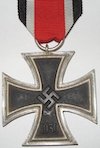 Perhaps the most famous and recognizable medal of World War II is the German Iron Cross. I’ve been a lifelong student of WWII all my life. I remember watching the hundreds of WWII films that were made in the 50s, and perhaps thousands since then, and more than one film has made reference to the Iron Cross. As a teen, I had a German couple who moved next door to my family in Dallas. He had served in the German Army as a photographer on the Eastern Front. He shared with my father and me many of the photographs he had taken. Until that moment, I did not know anything about the Eastern Front in WWII. You can see my published short story I wrote about meeting this German soldier in my blog post, “Like a Good German Soldier.” Sometime in the early 1980s, I once met a veteran in Berwick, Pennsylvania, who showed me a Luger and held an Iron Cross medal he had brought back from his service time in WWII.